Soprano, alto, tenor and baritone sax — what’s the difference?
Inleiding
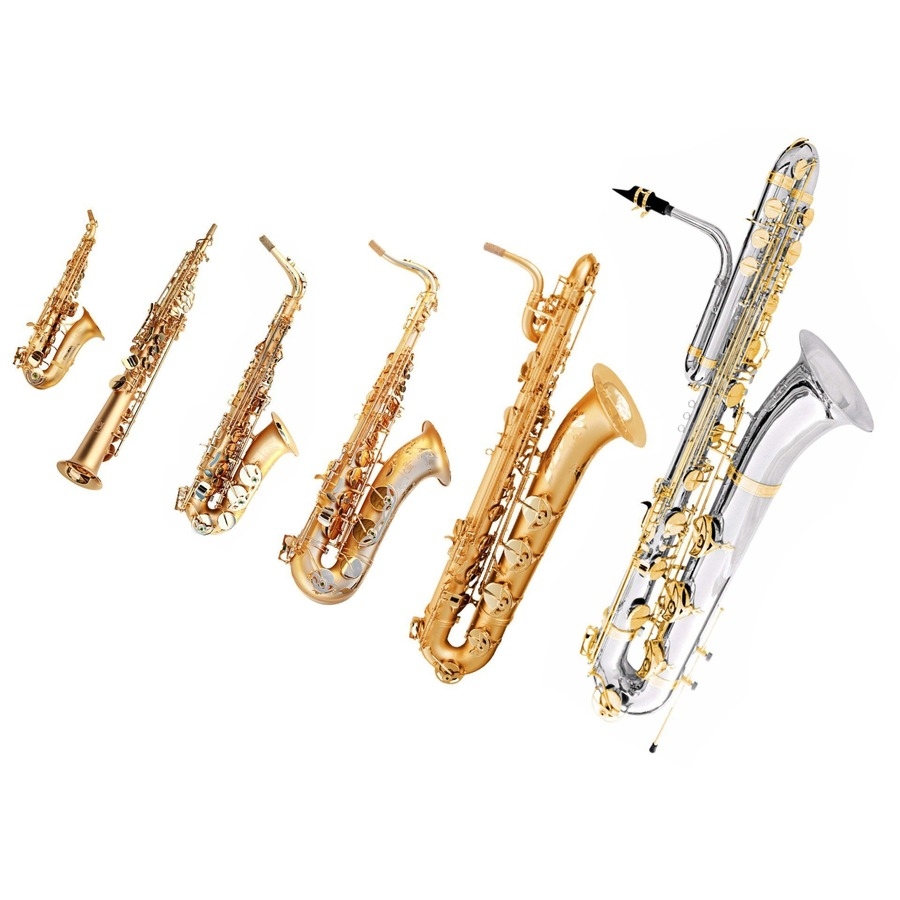
The saxophone family consists of several different types, each with its own unique characteristics. In this article, we explore the four most common saxophones and what sets them apart in terms of sound, shape and playing style.”
If you’ve ever seen a horn section on stage, you may have noticed that the saxophonists sometimes play instruments of different sizes, even instruments of different shapes. Sometimes they even switch their saxes from one song to the next.
Have you ever wondered why? If you think it’s because each type of saxophone produces a slightly different sound, you’re right — but that’s not where the differences end. In this article, we take a closer look at what distinguishes the four most common types of saxophones from one another, but first, let’s say a few words about the history of this fascinating and exceptionally versatile instrument.
Similarities
To begin with, all saxophones, regardless of type, are conical, meaning their tubes or bodies become wider from the mouthpiece to the end of the instrument. In addition, each of the tubes flares out into a bell shape at the end — a part that, fittingly, is known as the bell.
Saxophone bells
Furthermore, the keys on soprano, alto, tenor and baritone saxophones are essentially the same. A baritone sax may have an extra key for a lower note, or a soprano sax one extra for a higher note, but anyone familiar with one type of saxophone can play the others.
However, this is where the differences begin. While a piano has 88 keys — and therefore a wide range of notes — a saxophone has fewer possibilities. And because each saxophone varies in size, its range, as well as the amount of breath and physical strength required, also changes. Just as with singers, soprano indicates the highest voice, alto the next, followed by tenor and finally baritone.
Soprano saxophone
The soprano saxophone is the smallest (and lightest) of the four types and therefore has the highest pitch. For that reason it is more sensitive and thus more difficult to tune than the other three. Soprano saxes are usually tuned in B♭, the same tuning as many other orchestral instruments, including the trumpet.
Also, as fans of contemporary smooth jazz may have noticed, most soprano saxophones — unlike their three cousins — are straight rather than curved. Some modern soprano saxophones (such as the SML Paris SC620) have a curved neck and curved bell, allowing the player to adopt a more traditional playing position and giving the instrument the appearance of a very small version of its larger relatives.
.jpg "Soprano, alto, tenor and baritone sax — what’s the difference? - woodwinds_altosaxophone_eas451_au_040220_(1)")
Alto saxophone
Alto saxophones, which are almost always tuned in E♭, are the second-largest in size and have the second-highest pitch. Unlike the straight soprano, the alto sax has the shape of a “J”. Tenor and baritone saxophones are also J-shaped, but the neck of the alto sax bends sharply at nearly 90 degrees.
The curve in the neck of the alto sax adds more length to the tube. This not only extends the range downwards but also deepens the sound. A more extreme example of this principle is the tuba, which is very large and has many bends in both its neck and body.
Tenor saxophone
The tenor saxophone, the second-largest and second-lowest in the family, is the most widely played type of saxophone in popular music. It has a larger mouthpiece and reed than the soprano or alto, and is almost always tuned in B♭. As the legendary musician John Coltrane demonstrated, the tenor sax has been popular for a very long time — from the inventive jazz of the 1940s to the bebop and honking rock ’n’ roll of the 1950s, right through to the contemporary rock and R&B that millions enjoy today.
View our tenor saxophones here

Baritone saxophone
The baritone saxophone, which is tuned in E♭, is the largest and heaviest of the four. To lengthen the body of the baritone sax and make the lowest possible pitch achievable, the upper part of the neck features a twist, or “curly‑q” — a characteristic not found on any of the other saxophone types.
Because of their large size and very long neck, baritone saxophones require the most lung power and a particularly “open” (meaning relaxed) embouchure to produce the low rumble of their impressive tonal range. Nevertheless, more and more young musicians are choosing the baritone sax, especially since modern craftsmanship has made beginner models — such as the Yamaha YBS‑480 — lighter and easier to play.