Guitar effects: everything you need to know
.png "Guitar effects: everything you need to know - 0ntwerp_zonder_titel_(1)")
Inleiding
A guitar pedal is the way to shape and define your own sound. It alters the signal of your guitar before it reaches your amplifier, allowing your tone to become warm, rough, more spacious or focused. But how exactly does that work? What happens to the signal, and why does every pedal sound different? This page is an explanation.
What is a guitar effect pedal and what can you do with it?
A guitar pedal is an effects unit that allows you to shape and modify your guitar’s sound before the signal reaches your amplifier. It enables you to refine, enhance and customise your tone—for example by adding distortion, creating space, or giving your sound more character.
In practice, using pedals is rarely about having “as many effects as possible”. More often, guitarists use them to tailor their sound to match their playing style and the music they create. Pedals make it possible to explore different tonal directions with the same guitar and amplifier.
A guitar pedal can be a focused addition that clearly influences your sound. Think of an overdrive for extra saturation and dynamics, or a delay or reverb to make the sound more spacious and layered. A pedal doesn’t have to be a complex expansion; it is often a precise step towards refining your tone.
The key difference lies in how a pedal interacts with the rest of your setup. Factors such as your amplifier, guitar, settings and playing style all determine how a pedal behaves. As a result, pedals that look similar on paper can feel and sound quite different in practice.
What types of effect pedals are there?
Guitar pedals can broadly be classified by their function. Each category affects your sound in a different way. Below you’ll find an overview with a clear explanation of the most commonly used types.
Overdrive, distortion and fuzz
These pedals create distortion by allowing the signal to ‘clip’ in a .png "Guitar effects: everything you need to know - 00ontwerp_zonder_titel_(1)") controlled way. This produces additional overtones, resulting in a richer and more characterful sound. There are different levels of intensity, in the following order:
controlled way. This produces additional overtones, resulting in a richer and more characterful sound. There are different levels of intensity, in the following order:
controlled way. This produces additional overtones, resulting in a richer and more characterful sound. There are different levels of intensity, in the following order:Overdrive typically sounds dynamic and responds strongly to your playing. The effect is created by gentle, controlled clipping, allowing nuances in playing style and volume to remain clearly audible. This makes overdrive ideal for enhancing your core sound without completely altering it.
Distortion is tighter and more powerful, and is widely used in rock and metal. The signal is clipped more heavily and consistently, resulting in greater sustain and a more uniform distorted character. Distortion produces a sound that is less dependent on playing dynamics, offering stability and definition instead.
Fuzz takes things a step further, delivering a raw, often vintage-style sound. Very little of the original guitar signal remains intact. With fuzz in particular, the match with your guitar and amplifier can make a significant difference.
(1).png "Guitar effects: everything you need to know - ontwerp_zonder_titel_(3)(1)")
Modulation effects
Examples include chorus, phaser, flanger and tremolo. These effects add movement to your sound and are often used to create width, depth or a shimmering character. They are rarely used continuously, but rather applied at specific moments. A well-known example is the Boss CH-1 Super Chorus.
Delay and reverb
Both of these effects make your sound more spacious, each in i(1).png "Guitar effects: everything you need to know - ontwerp_zonder_titel_(1)(1)") ts own way. They are widely used to make your tone feel bigger and less “dry”. In practice, subtle settings often prove more effective than extreme ones.
ts own way. They are widely used to make your tone feel bigger and less “dry”. In practice, subtle settings often prove more effective than extreme ones.
ts own way. They are widely used to make your tone feel bigger and less “dry”. In practice, subtle settings often prove more effective than extreme ones.Reverb simulates the natural ambience of a space, such as a room or concert hall. This makes your guitar sound less dry and adds depth, atmosphere and space. Even in subtle amounts, reverb immediately gives your tone a more natural and expansive feel. The Boss RV-6 is a popular choice.
A delay pedal repeats your guitar signal after a set amount of time, creating echoes. From subtle thickening to rhythmic repeats, delay adds depth and character to your sound and can be used in virtually any genre. A popular and reliable option is the Boss DM-2W Delay.
.png "Guitar effects: everything you need to know - ontwerp_zonder_titel_(2)") Dynamics and utility pedals
Dynamics and utility pedals
This category includes compressors, volume pedals, equalisers and tuners. These pedals are often less noticeable than overdrives or delays, but play a crucial role in control, balance and playing comfort. They help make your sound more consistent, better adjusted and easier to manage. These are often the pedals players truly miss when they are no longer part of the setup. A good example is the MXR M102 Dyna Comp Compressor.
Which guitar pedals do I need to get started with?
There is no fixed set of pedals that works for everyone. In practice, a good starting point is about focus and preference rather than quantity.
What is essential for every guitarist is a tuner. In addition, many players choose one pedal to enhance their core sound. This is often an overdrive or distortion, but it could just as easily be a delay or reverb if atmosphere and space are more important in your playing. It is often worth considering eventually adding both.
The key point is that your first pedal does not need to do everything. One pedal that clearly adds something to your sound and works well within your setup will deliver far more value than several pedals that compete with each other. Start small and expand only once you have truly got to know your pedal and feel the need for something more.
In what order should I connect my guitar pedals?
The order in which pedals are connected determines how they interact. This can make a significant difference in both sound and playing feel, even with the same combination of pedals.
A commonly used signal chain is:
tuner → dynamics → overdrive/distortion → modulation → delay → reverb
.png "Guitar effects: everything you need to know - 000pedalen_volgorde(2)")
There are no rules here, but this is a logical starting point that works well in many setups. From there, many guitarists experiment further. Sometimes an unconventional order results in a sound that better suits a specific playing style.
What is the difference between analogue 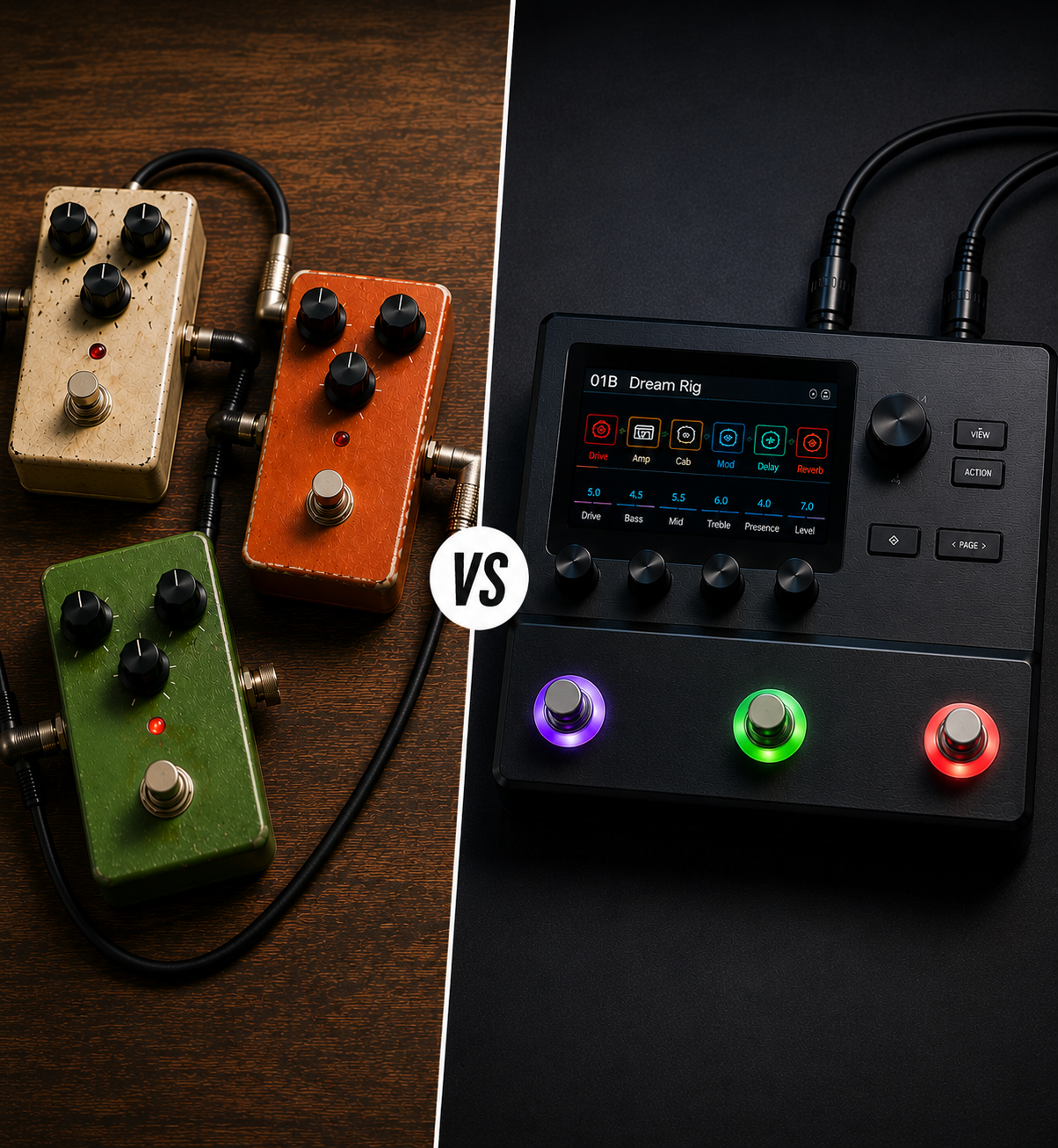 and digital pedals?
Analogue pedals use a traditional signal path and are known for their direct operation and characterful sound. Digital pedals use digital processing and often offer more features, presets and adjustment options.
In practice, this distinction is less decisive than it used to be. Many modern digital pedals sound excellent and are highly reliable, while analogue pedals remain popular for their simplicity and feel. The best choice depends mainly on how extensive your setup is and how you use your pedals.
How do I power my guitar pedals?
Guitar pedals can be powered via an adapter, a dedicated pedalboard power supply, or sometimes a 9V battery. Batteries are convenient for occasional use, but once you start using multiple pedals, a proper power supply quickly becomes the better option.
A good power supply not only adds convenience but also contributes to a more stable sound. In practice, many noise issues can be traced back to power and cabling, so this is worth investing in.
What is a pedalboard and do I need one?
A pedalboard is a fixed platform on which multiple pedals are mounted, usually with Velcro. It provides organisation, protection and a consistent setup.
For home use, a pedalboard is not essential, but it becomes very practical once you use several pedals. Everything stays connected and your settings remain intact. For live players, a pedalboard is often indispensable due to its speed and reliability. It also makes transporting your pedals to rehearsals or performances much easier.
Why does my pedal or setup produce noise?
Noise can result from power supply issues, cabling, gain settings or the combination of pedals. In many cases, noise can be reduced by using quality cables, a reliable power supply and a logical signal chain.
A small amount of noise at higher gain settings is normal. The goal is not absolute silence, but a setup that remains controlled and comfortable to play.
What should I consider when choosing a guitar pedal?
As with guitars, choosing a pedal is not just about specifications—it’s mainly about feel and inspiration. A pedal needs to suit your guitar, amplifier and playing style.
In practice, we often see guitarists start with a specific pedal in mind, but change their choice after comparing different models. Tone is personal and depends on factors such as your guitar, amplifier and playing style. Specifications provide a useful indication, but the final choice is often made after trying a pedal for yourself.
Prefer to order online?
Watching reviews and comparison videos can also help you make a decision. Here are a few recommendations:
Choosing an overdrive? A comparison – Boss SD-1 vs Ibanez TS9
https://youtube.com/shorts/vYbvIZM4RIg?si=V3tKgvKOVzd9RKRD
https://youtube.com/shorts/vYbvIZM4RIg?si=V3tKgvKOVzd9RKRD
Delay: analogue or digital? – Boss DD-3T vs Boss DM-2W Waza Craft
Digital Vs Analog Delay: Boss DD-3T and DM-2W Waza Craft
Digital Vs Analog Delay: Boss DD-3T and DM-2W Waza Craft
The ‘perfect’ chorus pedal? – Boss CH-1 Super Chorus
MusicMaker Presents - BOSS CH-1 SUPER CHORUS - The Perfect Chorus Pedal?
MusicMaker Presents - BOSS CH-1 SUPER CHORUS - The Perfect Chorus Pedal?
Overdrive vs distortion vs fuzz – Boss OD-1X Overdrive, Boss DS-1 Distortion, Boss FZ-5 Fuzz
MusicRadar Basics: overdrive, distortion, boost and fuzz pedals guitar explained - YouTube
MusicRadar Basics: overdrive, distortion, boost and fuzz pedals guitar explained - YouTube
A fuzz pedal for just 29 euros!? – Stagg Blaxx BX-FUZZ
BLAXX | BX-FUZZ Demo - YouTube
BLAXX | BX-FUZZ Demo - YouTube